KTX staff who helped Park Wi 300 times react to the one video he chose to post
Park Wi, a wheelchair-using YouTuber known for disability advocacy content, posted then quickly deleted CCTV footage of a fall he suffered while exiting a KTX train, setting off a backlash that has cost him subscribers and a scheduled speaking engagement. A lawyer appearing on a YouTube commentary channel says the clip's release may have violated South Korea's Personal Information Protection Act, even if the footage was obtained through proper channels.

Park Wi, whose YouTube channel Wiraclass documents life as a wheelchair user, posted CCTV footage on the 21st showing him falling while disembarking a KTX train, after his wheelchair wheel caught the foot of a civil service worker who was helping him off. He framed the upload as a call for better safety protocols and accessible transit infrastructure. By that same night he had deleted it and published an apology, but the fallout has continued.
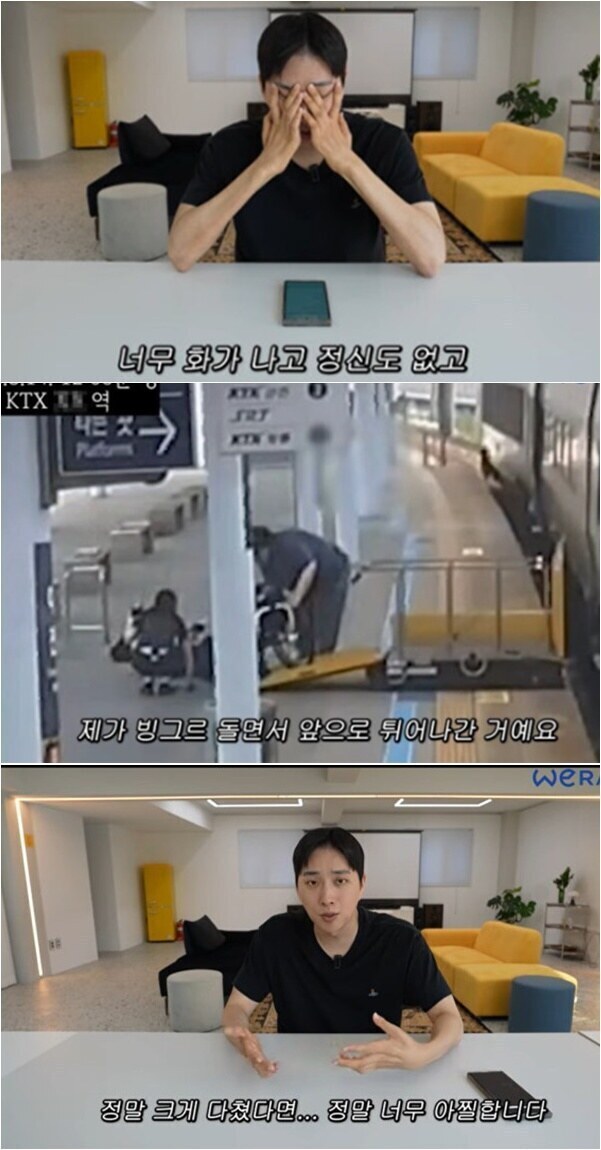
The backlash draws its sharpest edge from a detail baked into the footage itself: immediately after the incident, the civil service worker can be seen apologizing to Park Wi. Critics argued that posting footage of someone who had been actively trying to help, and who had already expressed remorse on camera, was disproportionate regardless of the stated public-interest motive.
What KTX staff had to say
A YouTube commentary channel reported receiving multiple tips from current and former KTX workers in the days after the incident. According to those accounts, Park Wi has boarded KTX trains roughly 300 times and has routinely received boarding and alighting assistance from staff throughout that period, without any recorded complaints. The staff members who reached out said they were not angry, but disheartened: that across hundreds of trips the working relationship had been uneventful, yet the one moment chosen for public exposure was a minor accident involving a lower-ranking civil service worker.
That context does not resolve the legal questions, but it shapes how the incident reads to people inside the industry. A single difficult moment, filmed and posted without apparent consideration for the worker on screen, can undo a long record of quiet cooperation.
The privacy law question
Attorney Lee Seung-jae, appearing on the commentary channel, laid out where the legal risk sits. Under South Korea's Personal Information Protection Act, a person directly involved in an incident can generally view relevant CCTV footage without a police officer present. Taking a copy of that footage, however, requires a written request specifying the purpose, and any third parties captured in the recording should ordinarily be masked or blurred before distribution.

Park Wi's video did apply a mosaic effect to the civil service worker's face. Lee argued this may not be sufficient: in a workplace setting, colleagues can often identify someone from body type, uniform details, or context alone, even without a clear view of the face. If the worker's identity became reasonably determinable to people who knew him, the blurring may not satisfy the law's intent.
On the question of whether a public-interest defense could shield Park Wi from liability, Lee was direct. Courts have found that even professional journalists claiming a public-interest rationale were not exempt from the Act when they disclosed identifiable personal information without consent. Publishing to a personal YouTube channel, he said, would face an even higher bar. Penalties for disclosure without consent typically result in fines; recent case law has produced judgments in the range of two million won, though the statute allows for imprisonment of up to five years in serious cases.
The aftermath
Park Wi's apology, posted on the night of the 21st, acknowledged that he had not considered the position of the worker who had been trying to help him. He wrote that he had failed to think through how significant the consequences of posting the video could be. The apology has not stopped the slide: his subscriber count has declined since the incident, and at least one scheduled speaking engagement has been canceled.
What the episode illustrates, beyond Park Wi's individual situation, is a tension that disability advocates and content creators navigating public infrastructure often face. Documenting barriers to accessibility is a legitimate and frequently necessary form of advocacy. When the documentation centers on an individual worker rather than a systemic failure, however, the line between raising awareness and assigning blame to a specific person becomes harder to defend, legally and otherwise.
Trending Now
- 1
SM Gets US Court Order in 9 Days to Unmask RIIZE Seunghan Comeback Accounts
K-Pop · October 17, 2026
- 2
Where to Actually Buy Korean Fashion Online
K-Fashion · August 24, 2026
- 3
SHINee's Taemin Meets Son Heung-min After a Falcon Launch in a TAEMIN 93 Jersey
K-Pop · October 16, 2026
- 4
Kim Yoo-jung and Park Jin-young's 100 Days of Lies Tops Its Slot at 8.3%
K-Drama · October 13, 2026
- 5
Kim Ji-won's Doctor X Hits 15.1% in Three Episodes, Two Years After Queen of Tears
K-Drama · October 17, 2026
More from Soo Park
Theqoo Says Ordinary Men Are Rare: One Commenter's Ex Fit All 10 and Still Cheated
Culture · October 21, 2026
Why Does Yim Si-wan Ban Seol In-ah From One Room in My Guilty Human?
K-Drama · October 21, 2026
Along with the Gods Gets a Third Film a Decade After Its 2017 Debut
Culture · October 20, 2026
End of story. The OMONAR Desk.
Don’t hear it from the group chat.
Comebacks, castings and chaos, filed by the desk.
Weekly · Free · Leave whenever