Korean Sunscreen vs. American Sunscreen, Explained
Korean sunscreen feels weightless and American sunscreen usually does not, and the reason is regulatory rather than cosmetic. The US treats sunscreen as a drug, Korea treats it as a functional cosmetic, and every difference you can feel on your skin follows from that one split. This month, for the first time in 25 years, the split got slightly narrower.

If you have ever put on a Korean sunscreen after years of American ones, you have probably had the same reaction: this cannot possibly be SPF 50. It goes on like a light moisturizer, leaves no white cast, and sits under makeup without pilling. The instinct is to assume it is doing less. It is not, or at least not for the reason you think. The difference traces back to a regulatory decision made in Washington decades ago, and it has just started, barely, to change.
One is a drug, the other is a cosmetic
In the United States, the FDA regulates sunscreen as an over-the-counter drug. That single classification is the root of the whole story. Adding a new UV filter to the approved list means clearing the OTC monograph process, which demands drug-grade safety data, and for a quarter of a century it produced nothing at all.
In South Korea, the Ministry of Food and Drug Safety regulates sunscreen as a "functional cosmetic," the same category that covers brightening and anti-wrinkle claims. It carries real testing requirements, but it is a cosmetics framework rather than a drug framework, and new filters enter it far more easily. Korean formulators have spent that quarter century reaching for filters Korea shares with the EU and Japan, while American ones worked from a list that did not move.
What just changed
On June 9, 2026, the FDA finalized an order adding bemotrizinol to the OTC sunscreen monograph, at concentrations up to 6 percent for adults and children six months and older. The order took effect on August 9. It is the first new UV filter cleared for American sunscreen since the late 1990s.
If bemotrizinol sounds unfamiliar, its trade name will not: it is Tinosorb S, which has been on Korean, Japanese, and European ingredient lists for years. So the single most-cited example of the transatlantic sunscreen gap is, as of this month, no longer an example.
Two things to hold alongside that. The ingredient's developer holds an 18-month period of market exclusivity, so it will be a while before it appears widely across American shelves. And one filter is one filter. The list below is what Korean formulators can still reach for and American ones still cannot.
The filters that make the difference
Tinosorb M (methylene bis-benzotriazolyl tetramethylbutylphenol), unusual in that it both absorbs and scatters UV rather than doing only one.
Uvinul A Plus (diethylamino hydroxybenzoyl hexyl benzoate), a dedicated UVA filter that holds up in sunlight far better than older UVA options.
Tinosorb S (bis-ethylhexyloxyphenol methoxyphenyl triazine), broad-spectrum and unusually photostable, and the one that just crossed over.
The American workhorse for UVA has long been avobenzone, which is effective but famously unstable, so US formulas spend part of their budget on stabilizers like octocrylene just to keep it working. Newer filters need less propping up. That frees room in the formula for texture, which is the part you actually notice.
Why the bottle says PA++++
SPF means the same thing in both countries, and it measures one thing: protection against UVB, the wavelengths behind sunburn. It tells you nothing about UVA, the longer wavelengths tied to photoaging and pigmentation.
Korean and Japanese labels handle UVA with the PA scale, from PA+ to PA++++, derived from a test called Persistent Pigment Darkening. More plus signs means more measured UVA protection. American labels answer the same question with a single pass or fail phrase: "broad spectrum." A US bottle reading broad spectrum SPF 50 tells you it cleared a threshold. A Korean bottle reading SPF50+ PA++++ tells you roughly where it landed. Neither system is dishonest. One is just higher resolution.
Texture is a consequence, not a marketing choice
The weightlessness people associate with Korean sunscreen is downstream of everything above. Modern filters dissolve more readily and stay stable at lower concentrations, so a formulator can hit a high rating without loading the base with heavy oils or a large dose of zinc. Add a domestic market where a very large number of people wear sunscreen daily under makeup, and you get relentless competition on finish. Essence textures, watery gels, tone-up milks, and stick formats all exist because the base chemistry left room for them.
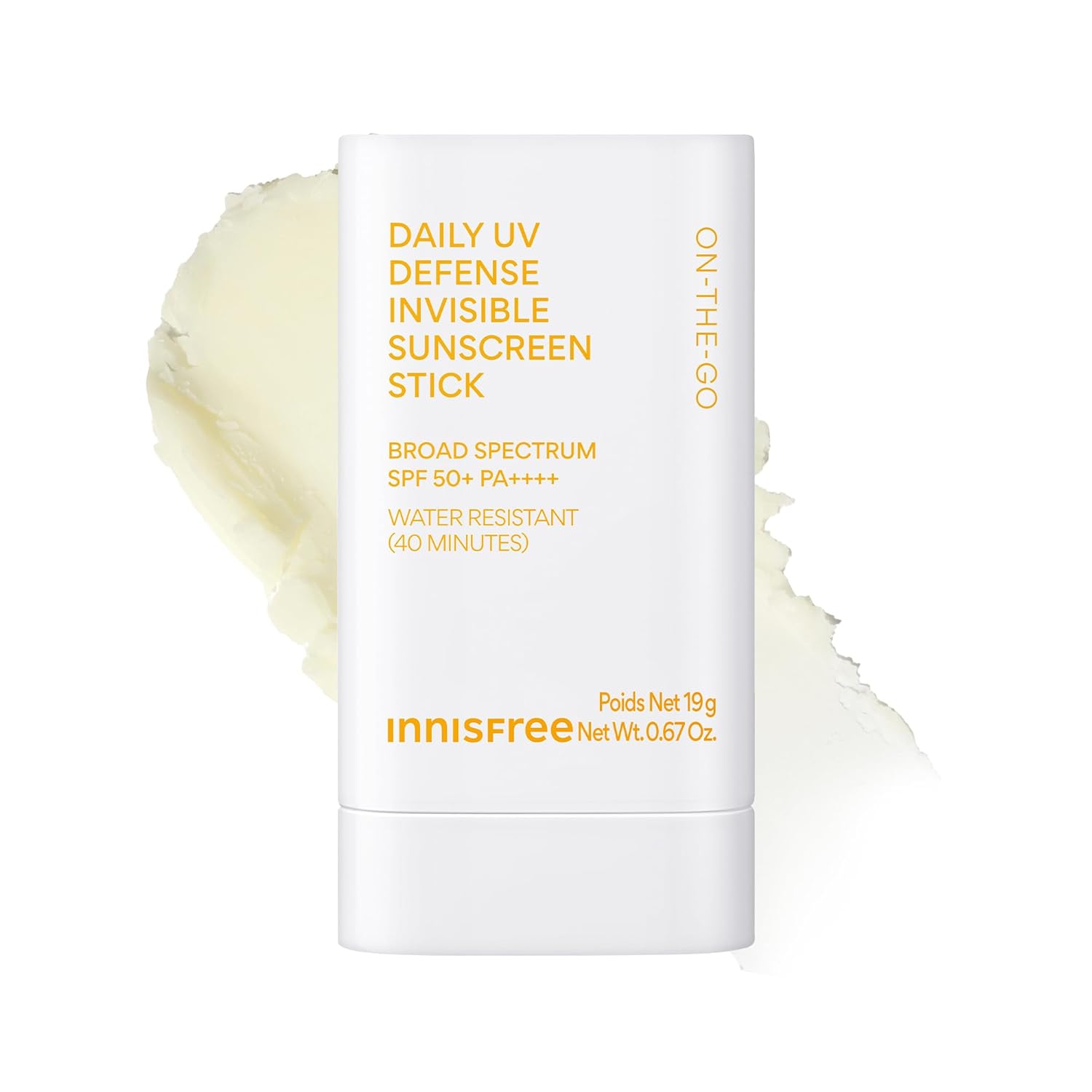 Innisfreeinnisfree Daily UV Defense Invisible Sunscreen Stick SPF50 0.67 oz.(19ml)$22.00Shop at Olive Young US →
Affiliate link. OMONAR may earn a commission if you buy.
If finish is the reason you are shopping this category at all, our roundup of the best Korean tinted sunscreens breaks the options down by the look each one gives you.
What this does not mean
Two caveats, because this is the part most articles skip.
First, a Korean sunscreen imported into the United States is almost always sold as a cosmetic, not as an FDA-regulated sunscreen. Its SPF number was validated under Korean rules, not American ones, and no US agency has checked it. That is not an accusation. It is a different chain of custody, and worth knowing.
Second, that chain has failed before. Independent third-party testing has more than once found Korean sunscreens delivering meaningfully less protection than their labels claimed. Favor brands that publish their test data, and treat an unusually cheap unbranded bottle with the same suspicion you would anywhere else.
And the unglamorous truth that outranks all of it: how much you apply matters more than which filters are in it. Most people use a quarter to half the quantity used in SPF testing, which cuts real protection sharply no matter whose regulator wrote the rules.
The short version
Korean sunscreen is not lighter because it is weaker. It is lighter because Korea's regulators let formulators use filters the FDA spent 25 years not approving, and those filters are easier to build a pleasant texture around. That gap just narrowed by exactly one ingredient. Read SPF for UVB and PA for UVA, buy from a brand that publishes its testing, and then apply about twice as much as feels reasonable. That last step is the one that actually decides how protected you are.
Trending Now
- 1
SM Gets US Court Order in 9 Days to Unmask RIIZE Seunghan Comeback Accounts
K-Pop · October 17, 2026
- 2
SHINee's Taemin Meets Son Heung-min After a Falcon Launch in a TAEMIN 93 Jersey
K-Pop · October 16, 2026
- 3
Kim Yoo-jung and Park Jin-young's 100 Days of Lies Tops Its Slot at 8.3%
K-Drama · October 13, 2026
- 4
Where to Actually Buy Korean Fashion Online
K-Fashion · August 24, 2026
- 5
Kim Ji-won's Doctor X Hits 15.1% in Three Episodes, Two Years After Queen of Tears
K-Drama · October 17, 2026
More from Seo-Yun Baek
Kim Yoo-jung's Bare-Shoulder Dress Photos Sit Oddly Beside Her Two-Week Fasting Story
K-Fashion · October 18, 2026
277% Sales Jump: The Underwear Trend Jennie and IVE Are Behind
K-Fashion · October 11, 2026
BLACKPINK's AI Hanbok Photoshoot Has Fans Divided Over Cultural Accuracy
K-Fashion · October 11, 2026
End of story. The OMONAR Desk.
Don’t hear it from the group chat.
Comebacks, castings and chaos, filed by the desk.
Weekly · Free · Leave whenever