Snail Mucin: What It Does, and What It Does Not
Snail mucin is one of the few skincare ingredients that people find genuinely off-putting and buy anyway, which tells you something about how well it performs. Most explanations of it come from brands with a stake in the answer. Here is what is actually in the bottle, what the research supports, and where the evidence runs out.
Snail mucin is the ingredient that made a generation of shoppers overcome a gag reflex. It is in essences, ampoules, creams, and sheet masks, it is the anchor product for more than one Korean brand, and it has the rare distinction of being both a punchline and a repeat purchase. What it is doing on your face is less commonly explained, mostly because the explanations come from people selling it.
What is actually in the bottle
The cosmetic ingredient is snail secretion filtrate: the mucus a snail produces, collected and filtered. In reputable production the snails are kept alive and the mucus is gathered without harming them, though methods vary by supplier and are worth asking about if that matters to you.
What makes it interesting is that it is not one ingredient, it is a mixture, and the components are things the skincare industry already sells individually:
Glycoproteins and glycosaminoglycans, large molecules that hold water and form a film.
Hyaluronic acid, the humectant that anchors half the hydrating serums on the market.
Glycolic acid, in small amounts, the same alpha hydroxy acid used in exfoliants.
Allantoin, a common soothing agent that also turns up on its own in ingredient lists.
Antimicrobial peptides and antioxidant compounds, the components that draw most of the research interest.
Read that list again and the appeal becomes obvious. It is a naturally occurring cocktail of ingredients that formulators would otherwise have to combine deliberately, arriving pre-mixed.
What it does
The clearest and least disputed effect is hydration. The glycoprotein and glycosaminoglycan fraction draws water and leaves a light film on the skin surface, which is the mechanism behind the immediate plumping people describe after a first use, and behind the slightly tacky finish that divides opinion.
Beyond that, most of the research sits in wound healing rather than cosmetics. Studies there have looked at snail secretion promoting fibroblast proliferation and collagen synthesis, which is the biological process behind skin repair, and other work has examined its anti-inflammatory and antimicrobial potential in the context of acne and rosacea.
That research is real, and it is also not the same thing as a proven cosmetic result. Laboratory findings about fibroblasts describe what cells do under study conditions. They do not establish that a given essence produces a visible change on a given face over a given number of weeks. Reviews of the ingredient tend to end on the same sentence: more robust clinical trials are needed.
What it does not do
Two claims travel with snail mucin that the evidence does not carry.
The first is acne treatment. The antimicrobial and anti-inflammatory work is genuinely interesting, but interesting is a long way from an established treatment, and persistent acne is a dermatologist's territory rather than a shelf's.
The second is exfoliation. Yes, there is glycolic acid in there. No, it is not present at a concentration that does what a glycolic toner does. If you want exfoliation, buy exfoliation.
It is also worth knowing that snail secretion filtrate concentration varies enormously between products, from a headline figure on the front of the bottle to a trace amount well down the ingredient list. The number on the box is worth reading.
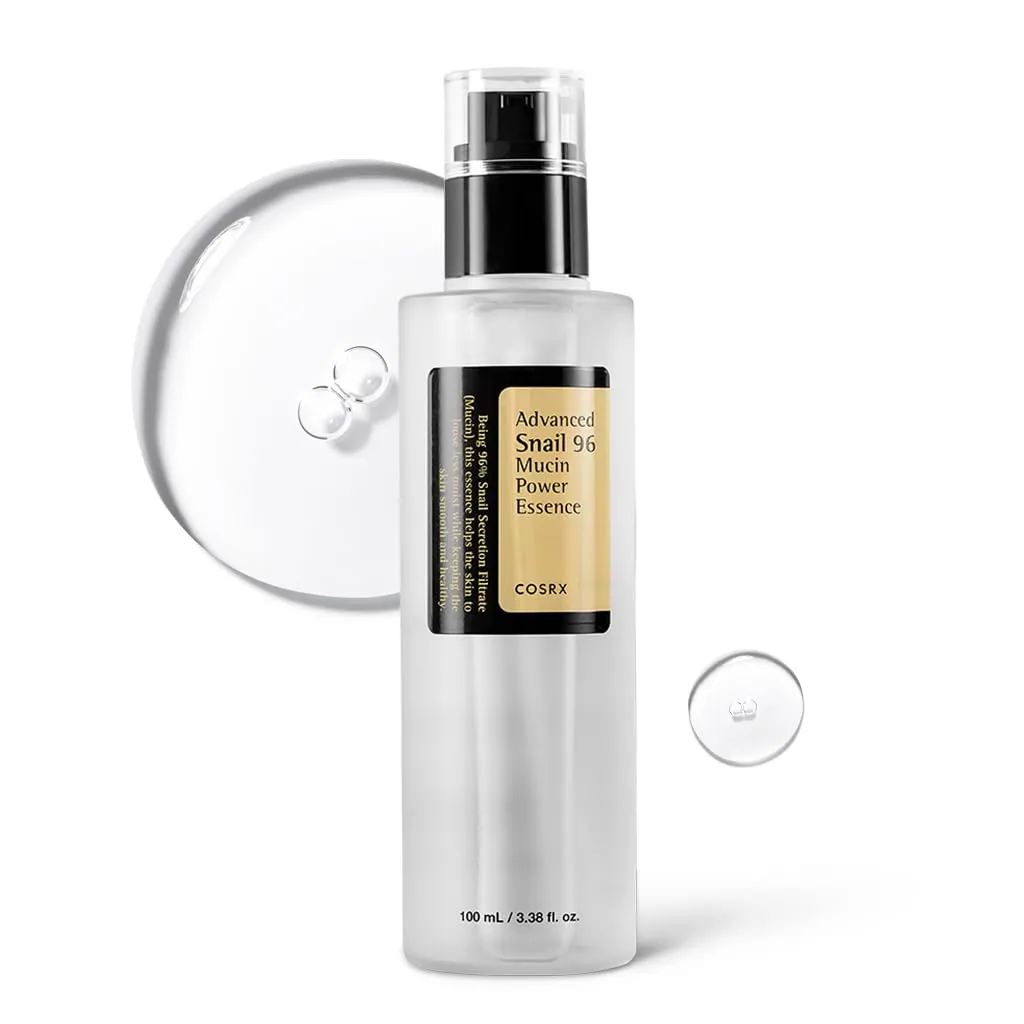 COSRXCOSRX Advanced Snail 96 Mucin Power Essence 3.38 fl. oz.(100ml)$20.90Shop at Olive Young US →
Affiliate link. OMONAR may earn a commission if you buy.
Who should skip it
People with a known shellfish or mollusc allergy have an obvious reason for caution, and anyone with reactive skin has the usual reason to patch test rather than apply a new ingredient to their whole face. Beyond that, snail mucin is generally regarded as low-irritation, which is a real part of why it became a staple: it is a hydrating step that most people can layer without consequence.
If the tacky finish is the dealbreaker, the honest answer is that a well-formulated hyaluronic acid serum with allantoin gets you most of the same hydration story without it. That is not a knock on snail mucin. It is the point: the mixture is doing recognisable things with recognisable ingredients.
The short version
Snail mucin is a genuinely effective hydrator with a nice supporting cast of soothing compounds, and a research file that is more promising than conclusive. Buy it as a hydrating step and you will probably be happy. Buy it as a treatment for a skin condition and you are ahead of the evidence.
The same "what is really in this" question is worth asking of the other big Korean shelf ingredients, from cica and centella to newer arrivals like PDRN.
Trending Now
- 1
SM Gets US Court Order in 9 Days to Unmask RIIZE Seunghan Comeback Accounts
K-Pop · October 17, 2026
- 2
SHINee's Taemin Meets Son Heung-min After a Falcon Launch in a TAEMIN 93 Jersey
K-Pop · October 16, 2026
- 3
Where to Actually Buy Korean Fashion Online
K-Fashion · August 24, 2026
- 4
Kim Yoo-jung and Park Jin-young's 100 Days of Lies Tops Its Slot at 8.3%
K-Drama · October 13, 2026
- 5
Ten Theqoo Replies, Five Animal Faces: Kitty and Wolf Types Win Out
Culture · October 15, 2026
More from Seo-Yun Baek
Kim Yoo-jung's Bare-Shoulder Dress Photos Sit Oddly Beside Her Two-Week Fasting Story
K-Fashion · October 18, 2026
277% Sales Jump: The Underwear Trend Jennie and IVE Are Behind
K-Fashion · October 11, 2026
BLACKPINK's AI Hanbok Photoshoot Has Fans Divided Over Cultural Accuracy
K-Fashion · October 11, 2026
End of story. The OMONAR Desk.
Don’t hear it from the group chat.
Comebacks, castings and chaos, filed by the desk.
Weekly · Free · Leave whenever